Jelly Force Official Website › Jelly Force Ingredients
Jelly Force IngredientsJelly Force Ingredients: The Nine Names on the Label
Jelly Force contains nine ingredients in a single 82 mg blend: muira puama, maca, catuaba, green tea extract, caffeine, ashwagandha, L-arginine, tribulus and horny goat weed.
The blend equals about 567 mg of dry powders, and caffeine is the only ingredient with its own printed amount, 5 mg per gummy.
For the full label, read the Supplement Facts panel.
Four have placebo-controlled trials in men. Two have no controlled human trial. Two carry an interaction question worth knowing about before the first gummy.
What the Jelly Force label actually names
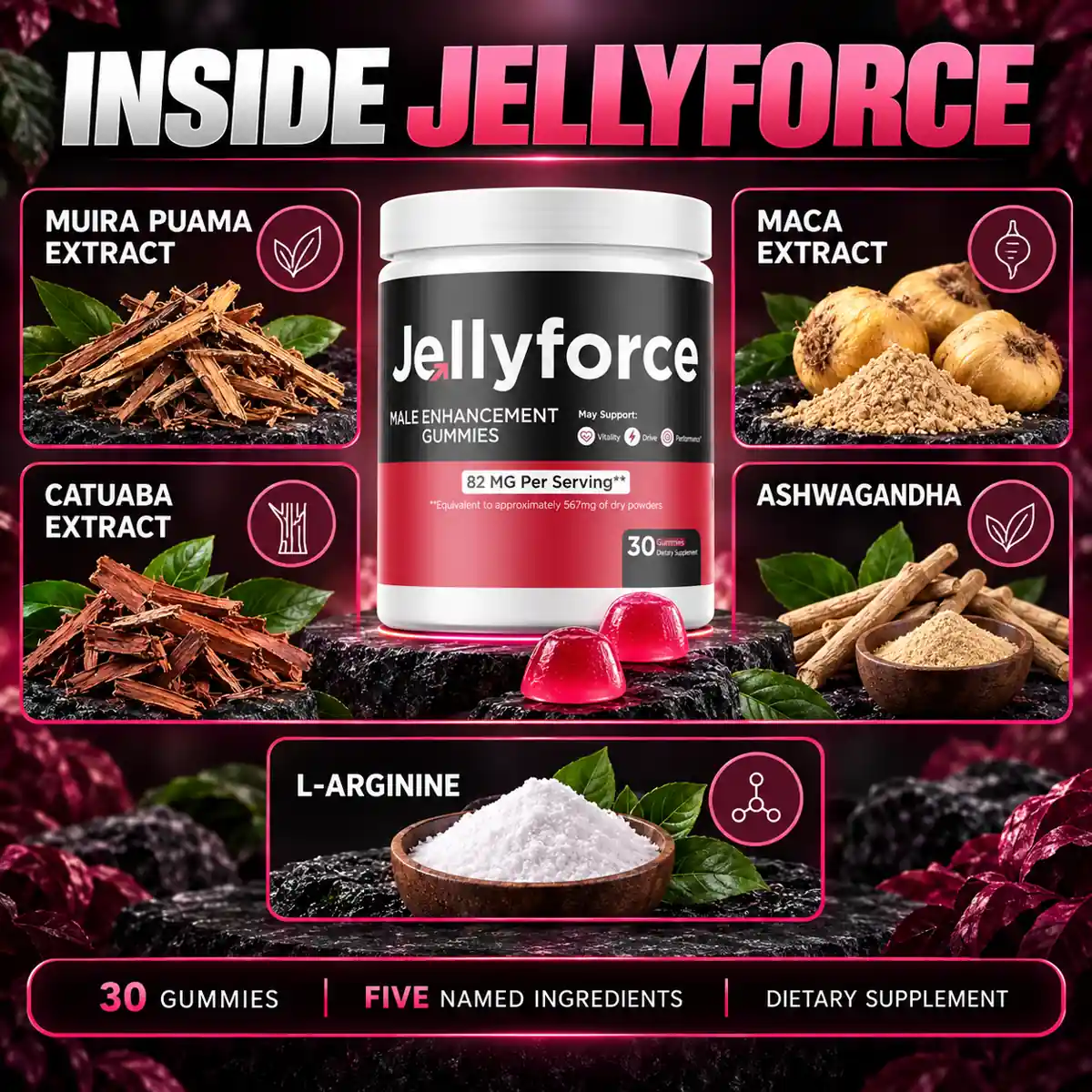
The brand's ingredient graphic, shown here, names five: muira puama, maca, catuaba, ashwagandha and L-arginine. The seller's written list names the same five. The Supplement Facts panel on the bottle names nine, adding green tea extract, caffeine, tribulus and horny goat weed.
The advertising names fewer than the bottle does, and the four it leaves out include the two with the most to say about interactions and safety. The panel is the regulated statement on the container you receive, so it is the list this page follows, name by name and in its order.
The split of the other 77 mg is the manufacturer's alone to know, and no guess stands in for it here. Caffeine is the only name with a printed amount, and a blend is almost never even. What the panel's order does allow is a ceiling: under the federal rule that blends list their names heaviest first, the four names printed after the 5 mg of caffeine would each weigh 5 mg or less. Where a share would be useful, what is printed instead is the trial dose, which is real.
The nine Jelly Force ingredients, one card each
Muira Puama Extract
Ptychopetalum olacoidesFirst of nine, no amount of its ownA root from the Brazilian Amazon, traded since the nineteenth century as marapuama or potency wood. It leads the panel and it is the weakest item on it by evidence: there is no controlled trial of muira puama in human beings in the indexed literature, for sexual function or for anything else. It reaches people only inside other products, in a one-month study of a ginkgo formula in women and a three-month pilot of a four-part mixture in men, neither with a placebo group and neither able to isolate the root.
What does exist is a body of rodent pharmacology from one Brazilian group. An extract inhibited acetylcholinesterase in mouse brain, and in a separate behavioural study the same kind of extract was anxiogenic rather than calming — which is the opposite of what a tonic is usually sold on, and is the reason it appears here. The root's chemistry has been properly catalogued, so this is a well-described plant with no human outcome attached to it.
Maca Extract
Lepidium meyeniiSecond of nine, no amount of its ownA cruciferous relative of the radish, farmed on the Peruvian altiplano at an altitude where almost nothing else is, and eaten locally by the spoonful. It carries more controlled human evidence on sexual desire than anything else on this panel.
A twelve-week randomised trial in men aged 21 to 56 gave 1,500 mg or 3,000 mg a day and found self-reported sexual desire improved from week eight. The same trial measured serum testosterone and oestradiol in the same men and found neither changed, which is the single most useful sentence about maca anywhere: whatever it does, it does not do it by raising testosterone. A second trial gave 2,400 mg a day of dry extract to fifty men with mild erectile dysfunction and found a small but significant advantage over placebo on the IIEF-5 questionnaire. A third, in eighty men with late-onset hypogonadism symptoms, dosed three times a day for twelve weeks and improved symptom and erectile scores.
The systematic review of this field is fair about its limits: few trials, small samples, mostly self-reported outcomes. The doses, though, are consistent. Every one of them is measured in grams.
Catuaba Extract
Trichilia catiguaThird of nine, no amount of its ownA Brazilian bark with one of the strongest folk reputations on the panel and no controlled human trial behind it. The name is also used commercially for at least two unrelated plants, so a label naming catuaba is naming a trade description rather than a species — this page uses Trichilia catigua because that is what the published pharmacology works on.
That pharmacology is real: antidepressant-like activity through dopaminergic mechanisms in rodents, and antioxidant, anticholinesterase and antifatigue effects in a later study. There is also a finding that no page selling this bottle has any business omitting: crude catuaba extract impaired fertility in adult female rats, though it did not damage the reproduction of male offspring. Jelly Force is sold to adult men, and the finding is in rats at doses unrelated to a gummy, so it is context rather than a warning. It is still the sort of context this desk would want to have been told.
Its only appearance in people is a twenty-eight-day safety study of Catuama, a Brazilian tonic mixing catuaba with muira puama, guarana and ginger. Healthy volunteers showed no severe reaction, and no benefit was measured.
Green Tea Extract
Camellia sinensisFourth of nine, no amount of its ownThe leaf of the tea plant, concentrated. It is on the panel and not in the seller's advertising, and the panel says nothing about what the extract is standardised to.
No trial of green tea extract on sexual function or stamina is cited on this website, because its literature is about other outcomes. What is cited is its safety record, because that record is specific: the US Pharmacopeia review of green tea extracts tied published liver-injury cases to intakes of the catechin EGCG from 140 mg to about 1,000 mg a day, and noted that concentrated doses taken on an empty stomach are absorbed the most.
The arithmetic here runs in the reassuring direction. The whole blend weighs 82 mg, the green tea extract is only part of it, and EGCG only part of the extract, so one gummy sits below the lowest intake in those reports.
Caffeine
the only individual amount printed5 mg a gummyPrinted as its own entry, Caffeine (5mg), between green tea extract and ashwagandha — the one number in the blend that belongs to a single name. The panel does not say whether it comes from the tea or is added separately, and it is not in the advertising.
5 mg is small. MedlinePlus gives an 8-ounce cup of tea at 14 to 60 mg and a cup of coffee at 95 to 200 mg, and a systematic review of caffeine safety found intakes up to 400 mg a day were not associated with adverse effects in healthy adults, and 300 mg in pregnancy. One gummy is an eightieth of the adult figure.
It is named anyway, because a buyer who avoids caffeine for sleep, heart rhythm or anxiety should be told rather than left to find it on the back of the bottle. The figure also does a second job, set out in the callout above: it anchors where the other names sit by weight.
Ashwagandha
Withania somniferaSixth of nine, printed after caffeineOne of the best-studied names on the panel, and the one with the largest file of published safety signals. In men, the trial record is specific: 675 mg a day in three doses for ninety days raised sperm count, volume and motility in forty-six oligospermic men, and 300 mg twice a day for eight weeks improved questionnaire scores for sexual function in fifty men with lower desire. A meta-analysis pooled the fertility work.
The counterweight is in the same literature and matters more than most caveats. A 2026 scoping review collected twenty-five patients across thirteen publications with liver injury attributed to ashwagandha: typically after weeks of use, typically cholestatic, usually reversible on stopping, and in one case severe enough to require transplantation. Separately, thyroid over-activity has been reported. The NCCIH page and the LiverTox monograph both carry it. None of that makes ashwagandha dangerous for most people. It makes liver disease, thyroid disease and thyroid replacement specific reasons to ask first.
One trial is worth noting for its scale rather than its result. A crossover study in aging, overweight men used a concentrated extract delivering 21 mg of withanolide glycosides a day and found fatigue and vigour did not separate from placebo, though DHEA-S and testosterone did shift. It is the trial closest in scale to a blended gummy, and it is the one that found the least.
L-Arginine
the amino acidSeventh of nine, printed after caffeineThe one amino acid on the panel, and mechanically the most transparent thing on it. Arginine is the substrate for nitric oxide synthase; nitric oxide relaxes the smooth muscle in a vessel wall; that relaxation is what an erection is, physically. The prescription drugs in this category work on the same pathway one step further along.
A meta-analysis of ten randomised trials in 540 men with mild to moderate erectile dysfunction found arginine supplements improved outcomes against placebo at daily doses from 1,500 mg to 5,000 mg. Eleven blood-pressure trials in 387 people, at 4 to 24 grams a day, found systolic pressure fell 5.4 mmHg and diastolic 2.7 mmHg.
Both of those numbers cut two ways on this bottle. They are evidence that the ingredient does something, and they are the reason the interaction section of this site is specific rather than general: anything else that widens a vessel is additive with it.
Tribulus Terrestris
Tribulus terrestris, puncture vineEighth of nine, printed after caffeineA low, spiny plant of warm dry ground whose fruit and leaf are sold as a vitality herb. It is on the panel and not in the advertising, and it has the most mixed human record on the bottle.
A twelve-week trial in 180 men with mild or moderate erectile dysfunction gave 1,500 mg a day of a standardised extract and found erectile scores improved against placebo. A thirty-day trial in thirty men at 800 mg a day found no difference from placebo on erectile scores or total testosterone. A 2026 meta-analysis of eight studies found erectile scores favoured tribulus and testosterone did not differ.
The testosterone claim so often attached to tribulus does not survive its own literature: a systematic review concluded it is ineffective for raising testosterone in humans. There is a safety file too: severe liver and kidney injury after two months of daily supplements, and an earlier kidney case. All of it at amounts far above any share of an 82 mg blend.
Horny Goat Weed Extract
Epimedium, species not statedNinth of nine, printed after caffeineLeaves of Epimedium, a genus of low woodland plants used in Chinese herbal medicine. Last on the panel and missing from the advertising. The panel names no species and no standardisation, and does not mention icariin, the compound most of the research is about.
What the record holds is laboratory work. Icariin inhibited PDE5 in test-tube work — the enzyme sildenafil and tadalafil block — at roughly three times the concentration of the reference inhibitor, and in another assay about eighty times more weakly than sildenafil. In castrated rats, oral icariin for four weeks improved erectile pressure while serum testosterone did not move. This desk found no trial of horny goat weed alone on sexual function in people.
Two case reports matter more to a buyer than the rat work: a racing heart rhythm with hypomania, and severe muscle spasms with raised creatine kinase after a month of a stand-alone supplement. And because its mechanism is the prescription tablets' mechanism, it joins arginine in the one interaction question on this bottle worth a telephone call.
Every Jelly Force ingredient beside the dose its research used
The research column carries the weight. Every trial figure in it is a daily amount from the study itself, and the smallest that moved anything in people, 600 mg of ashwagandha, is more than seven times the whole 82 mg blend and more than the 567 mg dry-powder equivalent of all nine names together.
That is not a scandal and it is not unique. It is what a nine-name blend in a gummy format is, arithmetically. What it does mean is that anyone buying this bottle on the strength of the maca, ashwagandha or tribulus trials is buying a name rather than a dose, and is entitled to be told so before they pay.
Jelly Force ingredient questions
How much of each ingredient is in Jelly Force?
The panel prints 82 mg for the blend of nine and one individual amount, 5 mg of caffeine. The other eight share the remaining 77 mg, and nothing on this website estimates the division.
Why does the Jelly Force advertising list only five ingredients?
The seller's graphic and written list name muira puama, maca, catuaba, ashwagandha and L-arginine. The Supplement Facts panel adds green tea extract, caffeine, tribulus and horny goat weed. This page follows the panel.
Which Jelly Force ingredient has the best evidence?
Maca, on desire and erectile scores; ashwagandha, on semen parameters and desire; and arginine and tribulus, on erectile scores. All were tested at doses far above what this bottle delivers.
Do any Jelly Force ingredients have no human research?
Two. Muira puama and catuaba have no controlled trial of their own in people in the indexed literature. Horny goat weed has no human sexual-function trial of its own that this desk could find.
Does Jelly Force contain caffeine or a stimulant?
Yes: 5 mg of caffeine a gummy, printed on the panel, beside green tea extract. MedlinePlus gives an 8-ounce cup of tea at 14 to 60 mg.
Who writes the Jelly Force ingredient pages?
- Siqueira IR, Fochesatto C, da Silva AL, et al. Ptychopetalum olacoides, a traditional Amazonian "nerve tonic", possesses anticholinesterase activity. Pharmacol Biochem Behav. 2003;75(3):645-50. Mice, not people. PMID 12895682. https://pubmed.ncbi.nlm.nih.gov/12895682/
- da Silva AL, Bardini S, Nunes DS, Elisabetsky E. Anxiogenic properties of Ptychopetalum olacoides Benth. (Marapuama). Phytother Res. 2002;16(3):223-6. PMID 12164265. https://pubmed.ncbi.nlm.nih.gov/12164265/
- Tian X, Guo S, He K, et al. Qualitative and quantitative analysis of chemical constituents of Ptychopetalum olacoides Benth. Nat Prod Res. 2018;32(3):354-357. PMID 28750557. https://pubmed.ncbi.nlm.nih.gov/28750557/
- Waynberg J, Brewer S. Effects of Herbal vX on libido and sexual activity in premenopausal and postmenopausal women. Adv Ther. 2000;17(5):255-62. 202 women, a combined muira puama and Ginkgo biloba product for one month, rated against their own baseline with no placebo group. PMID 11186145. https://pubmed.ncbi.nlm.nih.gov/11186145/
- Nguyen S, Rajfer J, Shaheen M. Safety and efficacy of daily Revactin in men with erectile dysfunction: a 3-month pilot study. Transl Androl Urol. 2018;7(2):266-273. Fifty-four men given a stated total daily dose of 500 mg of ginger root, muira puama and Paullinia cupana with 1,600 mg of L-citrulline; no placebo group, and one author held stock in the supplier and a pending patent on the product. PMID 29732286. https://pubmed.ncbi.nlm.nih.gov/29732286/
- Gonzales GF, Cordova A, Vega K, et al. Effect of Lepidium meyenii (MACA) on sexual desire and its absent relationship with serum testosterone levels in adult healthy men. Andrologia. 2002;34(6):367-72. Men aged 21-56 took 1,500 mg or 3,000 mg a day for twelve weeks; desire improved from week eight and testosterone did not move. PMID 12472620. https://pubmed.ncbi.nlm.nih.gov/12472620/
- Zenico T, Cicero AF, Valmorri L, et al. Subjective effects of Lepidium meyenii (Maca) extract on well-being and sexual performances in patients with mild erectile dysfunction: a randomised, double-blind clinical trial. Andrologia. 2009;41(2):95-9. Fifty men, 2,400 mg a day of dry extract for twelve weeks. PMID 19260845. https://pubmed.ncbi.nlm.nih.gov/19260845/
- Shin D, Jeon SH, Piao J, et al. Efficacy and Safety of Maca (Lepidium meyenii) in Patients with Symptoms of Late-Onset Hypogonadism: A Randomized, Double-Blind, Placebo-Controlled Clinical Trial. World J Mens Health. 2023;41(3):692-700. Eighty men, gelatinized maca dosed three times a day for twelve weeks. PMID 36593713. https://pubmed.ncbi.nlm.nih.gov/36593713/
- Shin BC, Lee MS, Yang EJ, et al. Maca (L. meyenii) for improving sexual function: a systematic review. BMC Complement Altern Med. 2010;10:44. Four trials, small samples, and the authors call the evidence limited. PMID 20691074. https://pubmed.ncbi.nlm.nih.gov/20691074/
- Campos MM, Fernandes ES, Ferreira J, et al. Antidepressant-like effects of Trichilia catigua (Catuaba) extract: evidence for dopaminergic-mediated mechanisms. Psychopharmacology (Berl). 2005;182(1):45-53. PMID 15991001. https://pubmed.ncbi.nlm.nih.gov/15991001/
- Martins NO, de Brito IM, Araujo SSO, et al. Antioxidant, anticholinesterase and antifatigue effects of Trichilia catigua (catuaba). BMC Complement Altern Med. 2018;18(1):172. PMID 29866157. https://pubmed.ncbi.nlm.nih.gov/29866157/
- Dos Santos AH, Ramos AC, Silveira KM, et al. The exposure to Trichilia catigua (catuaba) crude extract impairs fertility of adult female rats but does not cause reproductive damage to male offspring. J Ethnopharmacol. 2015;166:86-91. PMID 25792016. https://pubmed.ncbi.nlm.nih.gov/25792016/
- Oliveira CH, Moraes ME, Moraes MO, et al. Clinical toxicology study of an herbal medicinal extract of Paullinia cupana, Trichilia catigua, Ptychopetalum olacoides and Zingiber officinale (Catuama) in healthy volunteers. Phytother Res. 2005;19(1):54-7. Twenty-eight days of the mixture, watched for toxicity; no severe adverse reaction, and no benefit measured. PMID 15798997. https://pubmed.ncbi.nlm.nih.gov/15798997/
- Oketch-Rabah HA, Roe AL, Rider CV, et al. United States Pharmacopeia (USP) comprehensive review of the hepatotoxicity of green tea extracts. Toxicol Rep. 2020;7:386-402. Published case reports tie liver injury to EGCG intakes from 140 mg to about 1,000 mg a day. PMID 32140423. https://pubmed.ncbi.nlm.nih.gov/32140423/
- Wikoff D, Welsh BT, Henderson R, et al. Systematic review of the potential adverse effects of caffeine consumption in healthy adults, pregnant women, adolescents, and children. Food Chem Toxicol. 2017;109(Pt 1):585-648. Up to 400 mg a day in healthy adults, and 300 mg a day in pregnancy, not associated with adverse effects. PMID 28438661. https://pubmed.ncbi.nlm.nih.gov/28438661/
- MedlinePlus. Caffeine. U.S. National Library of Medicine. Gives an 8-ounce cup of coffee at 95-200 mg and an 8-ounce cup of tea at 14-60 mg. https://medlineplus.gov/caffeine.html
- Ambiye VR, Langade D, Dongre S, et al. Clinical Evaluation of the Spermatogenic Activity of the Root Extract of Ashwagandha (Withania somnifera) in Oligospermic Males: A Pilot Study. Evid Based Complement Alternat Med. 2013;2013:571420. Forty-six men, 675 mg a day in three doses for ninety days. PMID 24371462. https://pubmed.ncbi.nlm.nih.gov/24371462/
- Chauhan S, Srivastava MK, Pathak AK. Effect of standardized root extract of ashwagandha (Withania somnifera) on well-being and sexual performance in adult males: A randomized controlled trial. Health Sci Rep. 2022;5(4):e741. Fifty men, 300 mg twice a day for eight weeks. PMID 35873404. https://pubmed.ncbi.nlm.nih.gov/35873404/
- Lopresti AL, Drummond PD, Smith SJ. A Randomized, Double-Blind, Placebo-Controlled, Crossover Study Examining the Hormonal and Vitality Effects of Ashwagandha (Withania somnifera) in Aging, Overweight Males. Am J Mens Health. 2019;13(2):1557988319835985. An extract delivering 21 mg of withanolide glycosides a day for eight weeks; fatigue and vigour did not separate from placebo. PMID 30854916. https://pubmed.ncbi.nlm.nih.gov/30854916/
- Durg S, Shivaram SB, Bavage S. Withania somnifera (Indian ginseng) in male infertility: An evidence-based systematic review and meta-analysis. Phytomedicine. 2018;50:247-256. PMID 30466985. https://pubmed.ncbi.nlm.nih.gov/30466985/
- McIntyre D, Nguyen P, Kim Y, et al. Ashwagandha (Withania somnifera)-Associated Liver Injury: A Scoping Review of Clinical Characteristics and Safety Considerations. Cureus. 2026;18(5):e109764. Thirteen publications, twenty-five patients, injury usually appearing after weeks of use. PMID 42367407. https://pubmed.ncbi.nlm.nih.gov/42367407/
- Kamal HI, Patel K, Brdak A, et al. Ashwagandha as a Unique Cause of Thyrotoxicosis Presenting With Supraventricular Tachycardia. Cureus. 2022;14(3):e23494. PMID 35475098. https://pubmed.ncbi.nlm.nih.gov/35475098/
- LiverTox: Clinical and Research Information on Drug-Induced Liver Injury. Ashwagandha. Bethesda (MD): National Institute of Diabetes and Digestive and Kidney Diseases. NCBI Bookshelf NBK548536. https://www.ncbi.nlm.nih.gov/books/NBK548536/
- National Center for Complementary and Integrative Health. Ashwagandha: Usefulness and Safety. National Institutes of Health. https://www.nccih.nih.gov/health/ashwagandha
- Rhim HC, Kim MS, Park YJ, et al. The Potential Role of Arginine Supplements on Erectile Dysfunction: A Systemic Review and Meta-Analysis. J Sex Med. 2019;16(2):223-234. Ten randomised trials, 540 men with mild to moderate erectile dysfunction, doses of 1,500 to 5,000 mg a day. PMID 30770070. https://pubmed.ncbi.nlm.nih.gov/30770070/
- Dong JY, Qin LQ, Zhang Z, et al. Effect of oral L-arginine supplementation on blood pressure: a meta-analysis of randomized, double-blind, placebo-controlled trials. Am Heart J. 2011;162(6):959-65. Eleven trials, 387 people, 4 to 24 g a day; systolic pressure fell 5.4 mmHg. PMID 22137067. https://pubmed.ncbi.nlm.nih.gov/22137067/
- Kamenov Z, Fileva S, Kalinov K, Jannini EA. Evaluation of the efficacy and safety of Tribulus terrestris in male sexual dysfunction-A prospective, randomized, double-blind, placebo-controlled clinical trial. Maturitas. 2017;99:20-26. 180 men with mild or moderate erectile dysfunction, two 250 mg tablets of a standardised extract three times a day (1,500 mg) for twelve weeks. PMID 28364864. https://pubmed.ncbi.nlm.nih.gov/28364864/
- Santos CA, Reis LO, Destro-Saade R, et al. Tribulus terrestris versus placebo in the treatment of erectile dysfunction: A prospective, randomized, double blind study. Actas Urol Esp. 2014;38(4):244-8. Thirty men, 800 mg a day for thirty days; no difference from placebo on IIEF-5 or on total testosterone. PMID 24630840. https://pubmed.ncbi.nlm.nih.gov/24630840/
- Suharyani S, Amanda B, Angellee J, et al. Tribulus terrestris for management of patients with erectile dysfunction: a systematic review and meta-analysis of randomized trials. Int J Impot Res. 2026;38(1):11-18. Eight studies; erectile scores improved against placebo and total testosterone did not differ. PMID 40360723. https://pubmed.ncbi.nlm.nih.gov/40360723/
- Qureshi A, Naughton DP, Petroczi A. A systematic review on the herbal extract Tribulus terrestris and the roots of its putative aphrodisiac and performance enhancing effect. J Diet Suppl. 2014;11(1):64-79. Eleven studies; the authors conclude it is ineffective for raising testosterone in humans. PMID 24559105. https://pubmed.ncbi.nlm.nih.gov/24559105/
- Mohy-Ud-Din N, Jonassaint N. Severe Liver and Renal Injury From Tribulus Terrestris. ACG Case Rep J. 2024;11(2):e01267. A 46-year-old man after two months of daily tribulus supplements; he recovered. PMID 38328764. https://pubmed.ncbi.nlm.nih.gov/38328764/
- Talasaz AH, Abbasi MR, Abkhiz S, Dashti-Khavidaki S. Tribulus terrestris-induced severe nephrotoxicity in a young healthy male. Nephrol Dial Transplant. 2010;25(11):3792-3. PMID 20667992. https://pubmed.ncbi.nlm.nih.gov/20667992/
- Ning H, Xin ZC, Lin G, et al. Effects of icariin on phosphodiesterase-5 activity in vitro and cyclic guanosine monophosphate level in cavernous smooth muscle cells. Urology. 2006;68(6):1350-4. Icariin inhibited all three PDE5 isoforms at roughly three times the concentration the reference inhibitor needed. PMID 17169663. https://pubmed.ncbi.nlm.nih.gov/17169663/
- Dell'Agli M, Galli GV, Dal Cero E, et al. Potent inhibition of human phosphodiesterase-5 by icariin derivatives. J Nat Prod. 2008;71(9):1513-7. In the same assay icariin's IC50 was 5.9 micromolar and sildenafil's 74 nanomolar. PMID 18778098. https://pubmed.ncbi.nlm.nih.gov/18778098/
- Liu WJ, Xin ZC, Xin H, et al. Effects of icariin on erectile function and expression of nitric oxide synthase isoforms in castrated rats. Asian J Androl. 2005;7(4):381-8. Oral icariin at 1 or 5 mg per kg a day for four weeks; serum testosterone did not change. PMID 16281085. https://pubmed.ncbi.nlm.nih.gov/16281085/
- Partin JF, Pushkin YR. Tachyarrhythmia and hypomania with horny goat weed. Psychosomatics. 2004;45(6):536-7. A case report. PMID 15546831. https://pubmed.ncbi.nlm.nih.gov/15546831/
- Ledo T, Patel D, Tamaska W, et al. Herba Epimedium (Horny Goat Weed) Toxicity With Severe Muscle Spasms and Elevated Creatine Kinase and Creatinine: A Case Report. Cureus. 2025;17(5):e84608. A 33-year-old man after one month of an Epimedium supplement bought online. PMID 40546602. https://pubmed.ncbi.nlm.nih.gov/40546602/
- Code of Federal Regulations, Title 21, section 101.36(c)(2): the dietary ingredients in a proprietary blend are declared in descending order of predominance by weight. Legal Information Institute, Cornell Law School. https://www.law.cornell.edu/cfr/text/21/101.36
See the Jelly Force packs with the ingredient list in front of you
Nine names, one 82 mg blend, 5 mg of caffeine, and a sixty-day window to decide what it is worth. The two-bottle pack is the one that fits inside that window.
From $158 for two bottles to $294 for six, with 60 days on all three
Choose A Jelly Force PackChewed, one a day, 30 to a bottle. Batch JEL-26/JE-2800, shipped from the United States.